
Why Millets Are the Fastest Growing Agricultural Export Product in 2026
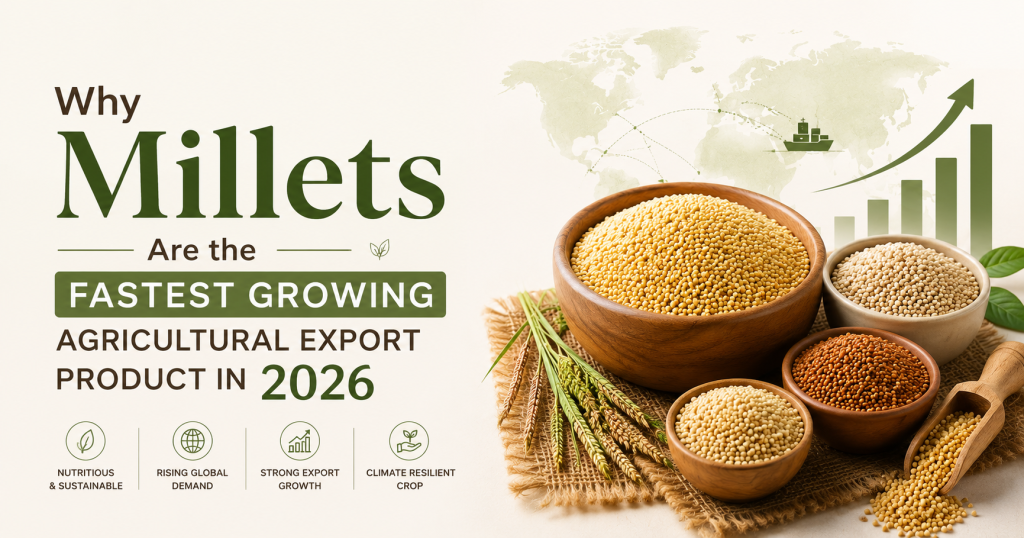
The global landscape of agro-commodities is experiencing a massive shift. While traditional staples like wheat and white rice face intense climate vulnerabilities and changing export regulations, a group of resilient, nutrient-dense ancient grains has taken the global market by storm: Millets. Driven by a global consumer migration toward gluten-free diets, sustainable farming, and functional nutrition, millets have emerged as the fastest-growing crop in international trade this year. For global procurement teams, health-food manufacturers, and distributors, aligning with an established agricultural products exporter in india is no longer just an alternative sourcing strategy it is the most profitable business move of 2026.
As the world’s largest single producer of millets, accounting for over 18% of global production and more than 38% of global Pearl Millet (Bajra), India stands at the absolute epicenter of this green revolution. In this comprehensive guide, we will break down the exact commercial vectors driving the 2026 millet boom and how to successfully navigate your supply chain.
1. The 2026 Global Demand Shock: Why Grains Like Bajra, Jowar, and Ragi are Dominating
The global market size for millets has breached its previous growth projections, expanding rapidly toward a multi-billion-dollar valuation. What was once classified as a rustic, localized crop is now a premium mainstream ingredient across North America, Europe, and the Middle East.
The Gluten-Free and Low-GI Market Drivers
Modern consumers are highly conscious of metabolic health. The exponential rise in lifestyle conditions like diabetes and celiac disease has forced a functional shift in food formulation. Millets are naturally gluten-free, low-glycemic index (GI), and loaded with dietary fiber, making them the ideal raw material for:
- Alternative Baking Flours: Replacing wheat flour in premium pastas, bread blends, and vegan cookies.
- Ready-to-Eat (RTE) Snacks: Puffed millet snacks, healthy cereals, and high-protein energy bars.
- The Brewing Industry: Sorghum (Jowar) is being heavily imported by global breweries for processing gluten-free beers and spirits.
Dual-Market Functionality: Human Food vs. Premium Animal Feed
A massive structural advantage for bulk buyers importing millets is their dual-market demand. While premium, machine-cleaned green millets command high prices in the retail health food sectors of the USA, UK, and GCC countries, massive industrial volumes of standard-grade Pearl Millet (Bajra) and Sorghum are simultaneously being secured by the global poultry and cattle feed industries as a highly nutritional, cost-effective substitute for corn.
2. Unlocking the Supply Chain: Sourcing from an Agricultural Products Exporter in India
When looking to build a resilient inventory, origin is everything. Sourcing your grains through a verified agricultural products exporter in india provides a distinct layout of commercial and logistical advantages that other regions simply cannot replicate.
+———————————————————————–+
| INDIA’S LEADING EXPORT MILLET VARIETIES |
+————————–+——————————————–+
| Pearl Millet (Bajra) | High iron, ideal for bulk feed & flatbreads|
| Sorghum (Jowar) | Excellent for gluten-free brewing & snacks |
| Finger Millet (Ragi) | Calcium powerhouse, booming in baby foods |
| Small Millets (Kodo/Fox) | Premium antioxidant-rich health-mix grains |
+————————–+——————————————–+
Unmatched Scalability and Year-Round Volume
Supported by major government initiatives like the Shree Anna scheme, India’s total annual millet production has climbed past 18 Million Metric Tonnes. With major agricultural states like Rajasthan, Karnataka, Maharashtra, and Gujarat putting massive acreage under structured cultivation, Indian exporters are uniquely positioned to offer unmatched scalability. Whether your business requires 1 Full Container Load (FCL) or thousands of tonnes of steady monthly supply, India delivers without seasonal bottlenecks.
3. Meeting Global Standards: The Blueprint for “Export Quality” Agro-Grains
Importing grains into strict regulatory zones like the European Union (EFSA) or the United States (FDA) requires meticulous adherence to quality metrics. A premium bulk agricultural products supplier ensures that the grain matrix meets stringent global benchmarks right from the processing stage.
Processing Millets for the Global Stage
Raw millets harvested from fields require extensive processing before they are considered export quality agricultural products. The top Indian exporters utilize ultra-modern industrial processing lines that execute:
- De-stoning and Pre-cleaning: Removing all physical impurities, chaff, and foreign matter.
- De-husking: Cleanly separating the outer hull without damaging the nutrient-dense grain inside.
- Color Sorting (Sortex): Advanced optical sorters ensure uniform color, shape, and size consistency, removing broken or discolored grains.
Moisture Stabilization: Keeping moisture levels strictly between 10% to 12% to halt any microbial growth or aflatoxin development during long container transits.
4. The Organic Surge: Tapping Into Premium Eco-Conscious Markets
For premium brands positioning their products in health food aisles, regular grains won’t suffice. The demand for organic agricultural products india has grown at an astounding compound annual rate over the past few years.
Traceability and Certification Compliance
Navigating organic imports requires robust certification frameworks. Top-tier Indian suppliers offer complete farm-to-fork traceability with fully compliant paperwork matching:
- USDA Organic certifications for North American entry.
- EU Organic standards for the European continent.
- NPOP (National Programme for Organic Production) guidelines, ensuring that no synthetic chemical pesticides, fertilizers, or GMOs have touched the crop during its life cycle.
By establishing an airtight supply chain with a certified partner, international buyers mitigate the severe financial risks of customs rejections and product quarantine.
5. B2B Logistical Framework: Key Shipping & Commercial Specs
For logistics and procurement managers planning their upcoming seasonal buy, here is a summary of the typical commercial specifications when importing millets through an established indian agriculture products export setup:
- Primary Export Ports: Mundra and Kandla (Gujarat) for rapid transit to the Middle East, Africa, and Europe; JNPT/Nhava Sheva (Mumbai) for deep-sea global shipments.
- Standard Packaging: 25 kg or 50 kg heavy-duty PP (Polypropylene) bags, multi-wall paper bags, or customized private-label vacuum pouches for retail-ready brands.
- Minimum Order Quantity (MOQ): Usually 1 FCL (approx. 20 to 24 Metric Tonnes depending on the specific millet type).
- Mandatory Export Documentation: Phytosanitary Certificate, Certificate of Analysis (CoA), Bill of Lading, Commercial Invoice, Packing List, and Certificate of Origin.
6. Frequently Asked Questions (FAQs) – Bulk Millet Sourcing
Q1: What is the differences between human-grade and feed-grade millets?
Human-grade millets undergo a premium Sortex cleaning process to ensure 99.9% purity, uniform coloration, and a complete absence of foreign material. Feed-grade millets focus primarily on nutrient volumes for livestock, allowing for minor variations in grain color and a slightly lower processing threshold, which reflects in a more economical FOB price per tonne.
Q2: How does your bulk agricultural products supplier preserve freshness during ocean freight?
To prevent moisture absorption and insect infestation during maritime transit, shipments are packed in seaworthy, double-layered bags with optional desiccant silica gel bags placed inside the containers. For premium or organic grades, vacuum-sealed packaging is highly recommended.
Q3: Why is India considered the safest bet for millet sourcing in 2026?
With erratic weather heavily disrupting grain outputs globally, India’s diverse agro-climatic zones and highly drought-resistant millet varieties ensure an uninterrupted, reliable crop yield. Furthermore, the extensive institutional backing from organizations like APEDA streamlines global customs documentation seamlessly.
Q4: Can we source processed millet derivatives like flour, flakes, or flakes in bulk?
Yes. Apart from whole raw grains, an experienced agricultural products exporter in india can supply value-added derivatives such as organic millet flour, sprouted ragi powder, and customized multi-millet industrial pre-mixes tailored to your manufacturing specifications.