
Top 7 High-Demand Indian Superfood Powders for Export
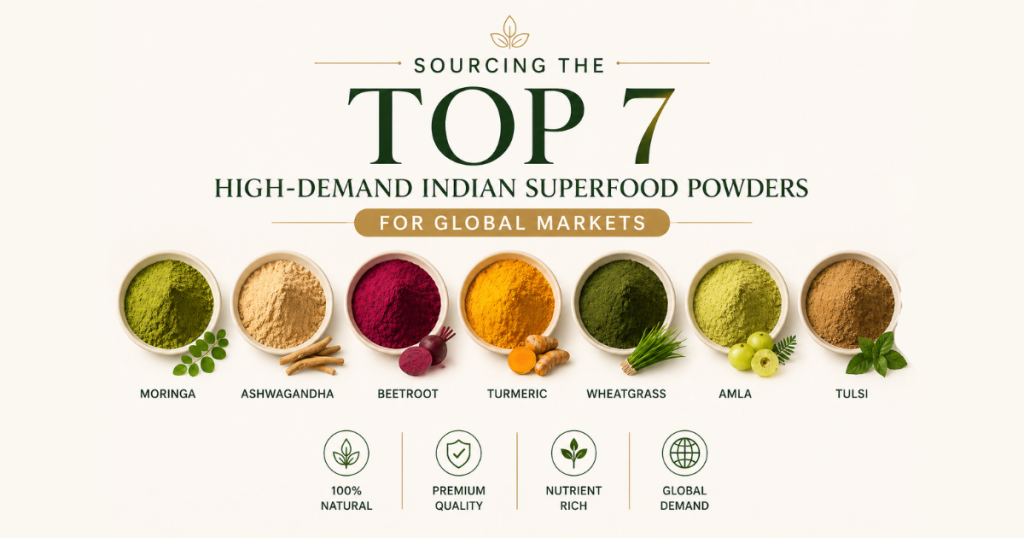
The global food, beverage, and wellness landscape has undergone a radical transformation over the last decade. Modern consumers are no longer satisfied with empty calories; they demand functional foods, immunity-boosting supplements, and clean-label beverages that actively contribute to their overall health and longevity. This massive shift in consumer behavior has catapulted the “Superfood” category into a multi-billion-dollar global industry.
At the very center of this botanical revolution stands India. Blessed with diverse agro-climatic zones and a deeply rooted history of Ayurvedic medicine, India is the world’s undisputed capital for cultivating and exporting medicinal herbs and agricultural superfoods.
For global dietary supplement manufacturers, functional food brands, cosmetic companies, and bulk distributors, sourcing these raw materials from India is a strategic necessity. However, the international market demands these ingredients in a highly specific format: finely milled, standardized, and export-quality powders. In this comprehensive, deep-dive guide, we will explore the top 7 high-demand Indian superfood powders, the complex science of botanical processing, stringent quality compliance, and how your business can build a bulletproof supply chain by partnering with Anugamya.
Chapter 1: Why Finely Milled Powders Dominate B2B Manufacturing
Before we examine the specific superfoods, it is crucial to understand why global manufacturers prefer bulk powders over whole herbs or liquid extracts. In the world of large-scale commercial production, the physical format of your raw ingredient dictates your manufacturing efficiency.
1. Unmatched Formulation Versatility Powders are the most adaptable format in the manufacturing world. They can be encapsulated into dietary supplements, compressed into multivitamins, blended into ready-to-drink (RTD) wellness beverages, mixed into vegan protein shakes, or incorporated into natural cosmetic face masks.
2. Uniformity and Standardization When dealing with whole herbs, standardizing a batch is nearly impossible due to natural variations in size and density. Powders, however, can be milled to an exact specification—commonly referred to as “mesh size.” A consistent 60, 80, or 100 mesh size ensures that the powder flows perfectly through automated encapsulation machines without clogging, ensuring precise dosing in every single pill or scoop.
3. Enhanced Shelf Life and Stability Fresh botanicals are prone to rapid degradation, mold, and rot. By carefully dehydrating the raw material to a moisture content of below 8% and milling it into a fine powder, the shelf life is dramatically extended. When packed securely in moisture-proof export liners, these bulk powders can remain potent and stable for 18 to 24 months, making global sea freight highly viable.
Chapter 2: Deep Dive into the Top 7 Indian Superfood Powders
The following seven botanical powders are currently experiencing exponential global demand. We have broken down their unique properties, industry applications, and the strict B2B sourcing standards required for each.
1. Moringa Powder (Moringa oleifera): The Green Nutritional Powerhouse
Known globally as the “Miracle Tree,” Moringa is one of the most nutrient-dense plants discovered to date. It is a rare plant-based source of complete protein (containing all nine essential amino acids) and is packed with Vitamin A, Vitamin C, Calcium, Potassium, and Iron.
-
- Global Industry Applications: Vegan protein blends, daily green superfood powders, nutritional smoothies, and anti-aging skincare formulations.
-
- The Sourcing Standard: The quality of Moringa powder is entirely dependent on its drying process. Substandard suppliers dry the leaves in direct sunlight, which bleaches the leaves yellow-brown and destroys the heat-sensitive vitamins and chlorophyll. Premium export-grade Moringa must be shadow-dried or dehydrated mechanically at very low temperatures. Buyers should always look for a brilliant, vibrant green powder with a fresh, grassy aroma.
2. Amla Powder (Phyllanthus emblica): The Vitamin C & Antioxidant Champion
Amla, or Indian Gooseberry, is a cornerstone of Ayurvedic medicine. It boasts an incredibly high concentration of natural, highly bioavailable Vitamin C, alongside a massive profile of tannins and antioxidants that fight cellular free-radical damage.
-
- Global Industry Applications: Immunity-boosting capsules, digestive health tonics, natural hair care products (often formulated alongside Shikakai and Reetha to strengthen hair follicles), and anti-aging supplements.
-
- The Sourcing Standard: Because Vitamin C is highly volatile and degrades quickly when exposed to heat, the milling process for Amla is critical. High-quality export Amla powder should have a uniform light brown color, a distinctly tart/sour aroma, and be completely free of fibrous seed remnants.
3. Ashwagandha Root Powder (Withania somnifera): The King of Adaptogens
Ashwagandha is no longer just an Indian remedy; it is a global superstar. As a powerful adaptogen, it directly interacts with the body’s endocrine system to lower cortisol (the stress hormone), improve sleep architecture, and boost physical endurance.
-
- Global Industry Applications: Stress-relief and anxiety gummies, nootropic (brain-boosting) stacks, sports nutrition and testosterone-support supplements, and nighttime recovery teas.
-
- The Sourcing Standard: B2B buyers typically look for root powder sourced from the nutrient-rich soils of regions like Nagaur in Rajasthan. The most critical factor is the milling temperature. Traditional grinding creates friction heat that can destroy the root’s active compounds, known as withanolides. Cool-grinding technology is mandatory to preserve its potency.
4. Turmeric Powder (Curcuma longa): The Golden Anti-Inflammatory
While the world knows turmeric as a culinary spice that gives curry its yellow color, the nutraceutical industry values it for its medicinal compound: Curcumin. Curcumin is one of the most heavily researched natural anti-inflammatories and antioxidants in modern science.
-
- Global Industry Applications: Joint-support and arthritis capsules, “Golden Milk” latte blends, gut-health immunity shots, and as a 100% natural, clean-label yellow food coloring.
-
- The Sourcing Standard: For superfood and supplement applications, standard culinary-grade turmeric is insufficient. B2B buyers must source specific high-curcumin turmeric cultivars (such as those from Erode, Salem, or Lakadong), which offer naturally high curcumin levels ranging from 3% to over 5%. Furthermore, because turmeric grows underground, stringent testing for heavy metals and steam sterilization to eliminate soil-borne bacteria is absolutely critical.
5. Triphala Powder: The Ultimate Digestive Detoxifier
Triphala translates directly to “three fruits.” It is a highly synergistic, traditional Ayurvedic blend consisting of equal parts Amla (Phyllanthus emblica), Bibhitaki (Terminalia bellirica), and Haritaki (Terminalia chebula). For centuries, it has been the gold standard for gentle, non-habit-forming bowel regulation and gut health.
-
- Global Industry Applications: Daily digestive enzyme blends, colon-cleanse and detox capsules, holistic wellness teas, and weight-management powders.
-
- The Sourcing Standard: The efficacy of Triphala relies entirely on the exact ratio and purity of the three fruits. Export-quality Triphala requires rigorous testing to ensure it is free from pesticide residues and aflatoxins (mold toxins), which can easily develop if the fruits are not dried properly before blending.
6. Brahmi Powder (Bacopa monnieri): The Cognitive Enhancer
As the global focus expands from physical health to mental longevity and cognitive performance, Brahmi is experiencing a massive surge in bulk demand. It is scientifically renowned for supporting memory retention, learning capacity, and overall brain health by stimulating the growth of nerve endings.
-
- Global Industry Applications: Nootropic supplement stacks, focus-enhancing energy drinks, and brain-health supplements formulated for seniors and students alike.
-
- The Sourcing Standard: Brahmi is a creeping herb that thrives in wet, marshy, and waterlogged environments. Because of this, it acts like a sponge, highly susceptible to absorbing heavy metals from the soil and water. Sourcing Brahmi requires partnering with a supplier who guarantees strict, independent laboratory screening for Lead, Arsenic, Cadmium, and Mercury.
7. Beetroot Powder: The Natural Stamina Booster
While not strictly an Ayurvedic herb, India is a massive cultivator of high-quality beetroot, and its powder format is a major export commodity. Beetroot is naturally abundant in dietary nitrates. When consumed, the human body converts these nitrates into nitric oxide—a vasodilator that widens blood vessels, improves blood flow, and lowers blood pressure.
-
- Global Industry Applications: Pre-workout athletic supplements, cardiovascular health formulas, and as a brilliant, 100% natural red/magenta food dye for clean-label confectioneries and beverages.
-
- The Sourcing Standard: Beetroot contains high levels of natural sugars, making its powder incredibly prone to clumping and caking when exposed to even minor humidity. Export-grade beetroot powder must have exceptional flowability, achieved through advanced spray-drying or freeze-drying techniques, and must be packaged immediately with desiccants in hermetically sealed bags.
Chapter 3: The Science of Processing From Raw Herb to Export-Grade Powder
Sourcing the raw plant is only 50% of the equation. The process of converting raw agricultural commodities into export-grade botanical powders is highly technical. If a supplier fails at any of these steps, the raw material is rendered useless for international B2B buyers.
Step 1: Harvesting and Sorting Quality begins at the farm level. Plants must be harvested at peak maturity to ensure maximum active compound levels. Once harvested, the raw material undergoes rigorous sorting (often using optical color sorters) to remove foreign matter, dirt, weeds, and substandard plant parts.
Step 2: Dehydration and Drying Moisture is the enemy of botanical powders. High moisture leads to microbial growth, yeast, and mold. However, drying must be done carefully. As mentioned with Moringa and Amla, high heat or direct sunlight destroys vitamins and essential oils. Premium exporters utilize controlled shadow-drying, solar dehydrators, or mechanical low-temperature air-drying to bring moisture levels below 8% safely.
Step 3: Cool Grinding Technology Traditional pulverizers and hammer mills generate immense friction. This friction creates heat, which essentially “cooks” the herb during the milling process, evaporating volatile aromatic oils and degrading heat-sensitive vitamins. Export-quality powders are produced using Cool Grinding or Cryogenic Milling. In this process, the grinding chamber is continuously cooled (sometimes using liquid nitrogen) to keep temperatures incredibly low, ensuring the botanical profile remains 100% intact.
Step 4: Steam Sterilization When herbs and spices are pulled from the earth, they naturally carry soil-borne microbes. For B2B buyers using these powders in ready-to-eat foods or beverages, these microbes pose a massive health risk. Steam sterilization is the global gold standard. It uses high-pressure steam to kill pathogens like E. coli and Salmonella naturally, without the use of harmful chemical gases (like Ethylene Oxide) or radiation.
Chapter 4: Navigating Global Quality Standards and Certifications
The international dietary supplement and food market is heavily policed by regulatory bodies like the US FDA, the European Food Safety Authority (EFSA), and the TGA in Australia. An imported shipment of bulk powder can easily be seized and destroyed at the port if it fails to meet strict safety criteria.
When sourcing from India, a bulletproof procurement strategy requires demanding the following from your supplier:
-
- The Certificate of Analysis (CoA): This is the most important document in botanical trading. A CoA from an accredited, independent third-party laboratory (like Eurofins or SGS) acts as the product’s passport. It must detail the physical appearance, mesh size, moisture content, active ingredient percentage, heavy metal profile, and microbiological load of that specific batch.
-
- Heavy Metal Compliance: Ayurvedic roots (like Ashwagandha) absorb minerals from the earth. Your supplier must prove that levels of Lead (Pb), Arsenic (As), Cadmium (Cd), and Mercury (Hg) fall well below the strict threshold limits set by your country’s health authorities.
-
- Pesticide Residue Limits (MRLs): Global markets have zero tolerance for banned agricultural chemicals. Export-quality powders must be tested to ensure they meet the Maximum Residue Limits for pesticides.
-
- GMP Certification: Good Manufacturing Practices (GMP) certification ensures that the supplier’s processing facility operates under strict hygienic and operational protocols, preventing cross-contamination between different botanical batches.
Chapter 5: Secure Your Global Supply Chain with Anugamya
Navigating the complexities of Indian agriculture, milling technologies, and international compliance requires more than just a vendor—it requires a dedicated, transparent supply chain partner. That is exactly what we offer at Anugamya.
At Anugamya, we specialize exclusively in the B2B trading of premium, export-quality herbal, Ayurvedic, agricultural, and spice powders. We have built our reputation on bridging the gap between India’s rich botanical harvests and the uncompromising quality demands of global manufacturers.
Why Partner with Anugamya?
-
- Uncompromising Quality Control: We don’t take chances. From ethically sourcing raw materials from vetted farming communities to utilizing advanced cool-grinding facilities, we ensure maximum potency in every batch.
-
- Full Transparency & Testing: Every bulk order dispatched by Anugamya is accompanied by rigorous, third-party laboratory testing and accurate CoAs, ensuring you never face compliance issues at your destination port.
-
- Customized Milling Solutions: We understand that a beverage brand needs a different powder consistency than a capsule manufacturer. We offer customized mesh sizes tailored specifically to your production line’s requirements.
-
- Flawless Export Packaging: We protect your investment. Our bulk powders are packaged in heavy-duty, multi-wall Kraft paper bags equipped with heat-sealed, moisture-proof LDPE inner liners. For highly sensitive powders, we utilize hermetically sealed HDPE drums to guarantee the product arrives in pristine condition, regardless of ocean transit times.
In an industry where purity and consistency define your brand’s success, Anugamya provides the reliability and excellence you need to scale. Partner with us today and secure a flawless supply of the world’s finest superfood powders.
Frequently Asked Questions (FAQs) for Bulk Buyers
1. What is the difference between an herbal powder and a standardized botanical extract?
An herbal powder is the entire plant part (leaf, root, or fruit) that has been dried and milled. It contains the full, natural spectrum of the plant’s compounds, fiber, and nutrients. A standardized extract, however, involves using solvents (like water or ethanol) to pull out and concentrate one specific active compound (e.g., extracting a 5% withanolide concentration from Ashwagandha), discarding the rest of the plant material. Powders are generally preferred for whole-food supplements, while extracts are used for highly targeted clinical formulations.
2. Why is mesh size so important when ordering bulk powders for manufacturing?
Mesh size refers to the number of openings per linear inch of a classifying screen. A 60-mesh powder is coarser than a 100-mesh powder. If you are manufacturing capsules, you need a specific mesh size that flows smoothly through your encapsulation machines without bridging or clogging. If you are creating a beverage mix, you need a very fine mesh (100+) so the powder dissolves easily in liquid without leaving a gritty residue at the bottom of the glass.
3. Are these Indian superfood powders safe to use in products formulated for children or pregnant women?
While botanicals like Amla and Moringa are generally considered very safe and highly nutritious food sources, adaptogens like Ashwagandha and herbs like Brahmi have potent physiological effects. As a B2B buyer or formulator, it is your responsibility to consult with clinical formulators and adhere to your local regulatory guidelines regarding the inclusion of specific Ayurvedic herbs in specialized products targeting vulnerable demographics.
4. How does steam sterilization affect the flavor and nutritional profile of the powder?
Unlike harsh chemical treatments or high-heat pasteurization, modern steam sterilization is incredibly rapid. It exposes the powder to high-pressure steam for only a few seconds. This is enough to destroy the cellular walls of harmful pathogens (bacteria, yeast, mold) while preserving the vast majority of the powder’s natural flavor, aroma, essential oils, and nutritional integrity. It is the safest and most effective method for the natural food industry.
5. What is the standard minimum order quantity (MOQ) for export shipments?
MOQs can vary significantly based on the rarity and processing requirements of the specific botanical. However, for standard export-quality powders like Moringa, Turmeric, or Ashwagandha, B2B shipments typically start at 500 kg to 1 Metric Ton (MT). This ensures that sea freight logistics and custom clearance costs remain economically viable for the buyer. At Anugamya, we work closely with our partners to establish scalable MOQs that fit their production schedules.