
India Export Guide: Herbal, Ayurvedic & Spices
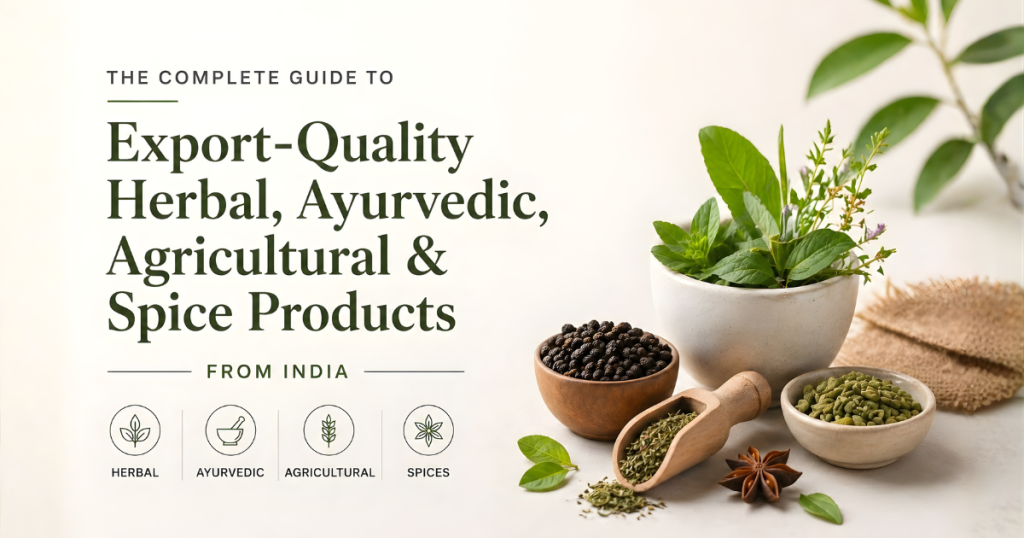
When global businesses think of sourcing raw botanical ingredients, spices, and agricultural commodities, all roads lead to India. For centuries, the Indian subcontinent has been the world’s primary source of aromatic spices and powerful Ayurvedic herbs. Today, that ancient legacy has evolved into a highly sophisticated, multi-billion-dollar export industry.
If you are a dietary supplement manufacturer in the United States, a food processing brand in Europe, or a wholesale distributor in the Middle East, understanding how to navigate the Indian export market is critical to your supply chain. You need ingredients that are not just affordable, but reliably pure, standardized, and fully compliant with international food safety regulations.
This comprehensive pillar guide is designed for B2B buyers, bulk traders, and brand owners. We will break down everything you need to know about sourcing export-quality herbal powders, whole spices, and agricultural products from India, ensuring you make informed, profitable procurement decisions.
Chapter 1: The Global Shift Toward Natural & Ayurvedic Solutions
Before diving into the specific commodities, it is essential to understand the market dynamics driving the demand for Indian exports. The global wellness economy is experiencing a massive paradigm shift. Consumers are actively moving away from synthetic chemicals and artificial additives, seeking out natural, plant-based, and holistic alternatives.
Ayurveda, the ancient Indian system of medicine, has moved from a niche alternative practice to mainstream global wellness. Global pharmaceutical companies, cosmetics brands, and food and beverage manufacturers are incorporating Ayurvedic principles into their product lines. This surge is driving an unprecedented demand for high-quality botanical raw materials.
However, the international market is uncompromising when it comes to quality. “Export-quality” is not just a marketing buzzword; it represents a strict set of parameters involving active compound percentages, microbiological safety, and ethical sourcing. Buyers require ingredients that maintain their efficacy from the farm in India to the factory floor halfway across the world.
Chapter 2: Deep Dive into Ayurvedic & Herbal Exports
India’s geographical diversity—from the freezing Himalayas to the tropical southern coasts—allows for the cultivation of a vast array of medicinal plants. For B2B traders, these herbs are most commonly sourced in fine powder form, which offers superior versatility for capsules, tablets, beverages, and cosmetic formulations.
Here is a closer look at the most sought-after export-quality herbal and Ayurvedic products:
1. Ashwagandha (Withania somnifera)
Ashwagandha is arguably the crown jewel of modern Ayurvedic exports. As a powerful adaptogen, it helps the body manage stress and anxiety, making it a star ingredient in the booming global nootropics and stress-relief market.
- Sourcing Focus: International buyers look for Ashwagandha root powder with a standardized percentage of withanolides (the active compound). Export-quality powder must be finely milled (typically 60 to 80 mesh size) for maximum solubility and absorption.
2. Moringa (Moringa oleifera)
Known globally as the “Miracle Tree,” Moringa leaf powder is a nutritional powerhouse. It is packed with vitamins, minerals, and antioxidants.
- Sourcing Focus: The key to export-quality Moringa lies in the drying process. Sun-drying can degrade its nutritional profile and alter its vibrant green color. Premium suppliers use shadow-drying or low-temperature mechanical dehydration to preserve the chlorophyll and nutrient density, resulting in a premium, bright green powder used in superfood blends and smoothies.
3. Turmeric/Curcumin (Curcuma longa)
While turmeric is a culinary spice, its medicinal properties place it firmly in the herbal supplement category. Curcumin, the active compound in turmeric, is highly prized for its anti-inflammatory properties.
- Sourcing Focus: For nutraceutical applications, buyers specifically source turmeric powder with high curcumin content (ranging from 3% to over 5%, or even highly concentrated extracts up to 95%). Sourcing from specific Indian regions like Erode or Salem ensures naturally higher curcumin levels.
4. Amla (Phyllanthus emblica)
Indian Gooseberry, or Amla, is one of the richest natural sources of Vitamin C and a primary ingredient in immunity-boosting supplements and hair care products.
- Sourcing Focus: Amla powder must be processed carefully to prevent oxidation, which destroys the Vitamin C content. Export-grade Amla powder is light brown, finely textured, and free from any fibrous residue.
5. Triphala, Brahmi, and Shatavari
- Triphala: A traditional blend of three fruits (Amla, Bibhitaki, and Haritaki) used for digestive health.
- Brahmi (Bacopa monnieri): A cognitive enhancer highly demanded in the West for brain-health supplements.
- Shatavari: Known for supporting female reproductive health and hormonal balance.
The Importance of Powdering Technology: When sourcing these herbs, the grinding process is critical. Traditional grinding generates heat, which can destroy the volatile oils and active medicinal principles of the herbs. Top-tier Indian exporters utilize “cool grinding” or cryogenic milling technologies to ensure the botanical integrity of the powder remains 100% intact.
Chapter 3: India – The Undisputed Spice Capital of the World
India produces, consumes, and exports more spices than any other country, accounting for over 70% of global spice production. The aroma, flavor profile, and oil content of Indian spices are unmatched. However, sourcing spices for international markets requires navigating a complex landscape of quality grading.
Key Export Spices and Their Requirements
Black Pepper (Piper nigrum)
Often referred to as “Black Gold,” Indian black pepper, particularly the Malabar and Tellicherry varieties, is world-renowned.
- Export Standards: Buyers evaluate black pepper based on bulk density (measured in grams per liter, e.g., 500 GL, 550 GL), moisture content (must be strictly below 11% to prevent mold), and piperine content. Export-quality pepper is visually sorted to remove pinheads, light berries, and extraneous matter.
Cumin (Cuminum cyminum) & Coriander (Coriandrum sativum)
These are staple ingredients in global spice blends, curry powders, and meat seasonings
- Export Standards: Cumin and coriander are sold both as whole seeds and ground powders. For whole seeds, purity levels (e.g., 99% or 99.5% pure) are critical. The seeds must be machine-cleaned and sorted using optical color sorters to ensure uniformity.
Cardamom (Elettaria cardamomum)
The “Queen of Spices” is one of the most expensive spices in the world, heavily demanded in the Middle East for traditional coffees and in Europe for baking.
- Export Standards: Cardamom is graded by size (e.g., 6mm, 7mm, 8mm+), color (deep vibrant green is preferred), and whether the pods are split or whole.
Spice Powders and Steam Sterilization
For food manufacturers, raw spices present a microbiological risk. Soil-borne pathogens like Salmonella or E. coli can be present on raw agricultural commodities. Therefore, export-quality spice powders must undergo strict sterilization.
The global gold standard is Steam Sterilization, which effectively reduces the microbial load without using harmful radiation or chemical treatments like Ethylene Oxide (EtO), which are banned in many European and North American markets.
Chapter 4: Agricultural Products & Dehydrated Commodities
Beyond medicinal herbs and culinary spices, India is a massive supplier of bulk agricultural products that form the base of the global food processing industry.
Dehydrated Onion and Garlic
India is a leading exporter of dehydrated onion (flakes, minced, chopped, and powder) and dehydrated garlic. These are essential for ready-to-eat meals, soups, sauces, and instant noodles worldwide.
- Quality Metrics: Buyers look for products processed in facilities with strict hygiene controls. The color must be bright (white, pink, or red depending on the onion variety), and the moisture content must be exceptionally low to prevent clumping and ensure a long shelf life.
Oilseeds (Sesame, Castor, Peanut)
Indian sesame seeds (hulled, natural, and black) are exported globally for use in baking, confectionery, and tahini production. Hulled sesame seeds must be auto-dried and optically sorted to ensure a brilliant white color and 99.95% purity.
Grains and Pulses
From premium Basmati rice, known for its extra-long grains and distinct aroma, to a wide variety of lentils and chickpeas, Indian agricultural exports feed millions globally. Export standards dictate stringent checks for broken grains, admixture, and moisture levels.
Chapter 5: Demystifying Quality Standards, Certifications & Compliance
The biggest hurdle for international B2B buyers is ensuring that the product arriving at their port matches the sample they approved. The international food and supplement industry is heavily regulated, and non-compliance can result in rejected shipments and massive financial losses.
When you are sourcing from India, a reputable supplier must adhere to the following quality parameters:
Heavy Metal Testing
Herbs and root vegetables absorb minerals from the soil. Unfortunately, this can include heavy metals like Lead, Arsenic, Cadmium, and Mercury. Export-quality products must be accompanied by an independent laboratory report confirming that heavy metal levels are well below the limits set by authorities like the USFDA and the European Food Safety Authority (EFSA).
Pesticide Residues
Modern agriculture relies on crop protection, but international markets have strict Maximum Residue Limits (MRLs) for pesticides. High-quality exporters work directly with farmers to ensure safe cultivation practices and conduct comprehensive screening to guarantee products are residue-free or within permissible limits.
Aflatoxin and Mycotoxin Control
Spices like chili and peanuts are highly susceptible to aflatoxins (toxic compounds produced by certain molds). Stringent moisture control during drying and storage is essential to prevent mold growth. Export shipments require specific Aflatoxin testing certificates.
Essential Certifications
A reliable bulk supplier in India should be able to provide or operate under several of the following certifications:
- FSSAI: Food Safety and Standards Authority of India (Mandatory).
- GMP (Good Manufacturing Practices): Crucial for herbal powders intended for supplements.
- ISO 22000 / HACCP: Ensuring robust food safety management systems.
- Organic Certifications: Such as NPOP (India), USDA Organic (USA), or EU Organic, for buyers seeking premium organic ingredients.
The Certificate of Analysis (CoA)
Never buy bulk commodities without a CoA. This document is the “passport” of the product, detailing its physical appearance, chemical composition, microbial load, and active ingredient percentages, proving it meets your exact specifications.
Chapter 6: Sourcing, Packaging & Supply Chain Logistics
Once the right quality is identified, the next challenge is getting it from India to your warehouse intact.
Sourcing Strategies
While platforms like IndiaMart and TradeIndia are excellent starting points for price discovery, they can be overwhelming due to the sheer volume of unverified suppliers. Successful global buyers often move beyond these directories to build direct relationships with specialized trading houses or manufacturers who act as their eyes and ears on the ground. A dedicated partner handles the vetting, quality control, and consolidation of multiple commodities into single shipments.
Export Packaging Solutions
Packaging is the final, crucial defense against product degradation. The journey from an Indian port to destinations in North America or Europe can take several weeks, exposing the cargo to fluctuating temperatures and high humidity on the open ocean.
- For Powders: Export-quality herbal and spice powders are typically packed in 25kg or 50kg multi-wall Kraft paper bags with an inner food-grade LDPE liner. The liner must be completely moisture-proof and sealed airtight.
- For High-Value Items: Premium botanical extracts or expensive spices may be packed in heavy-duty HDPE drums.
- Vacuum Packaging: For products prone to oxidation or flavor loss, vacuum packing is employed before placing them in corrugated master cartons.
Shipping & Documentation
A seamless supply chain relies on flawless documentation. A reputable Indian exporter will provide a complete set of shipping documents promptly, including:
- Commercial Invoice & Packing List
- Bill of Lading (B/L)
- Certificate of Origin
- Phytosanitary Certificate (issued by Indian plant quarantine authorities confirming the shipment is free of pests)
- Fumigation Certificate (if applicable, ensuring wooden pallets or raw goods are pest-free).
Chapter 7: Why Anugamya is Your Ideal Sourcing Partner in India
Navigating the complexities of the Indian agricultural and botanical market requires more than just a supplier; it requires a strategic partner. This is where Anugamya steps in.
At Anugamya, we have built our foundation on trust, transparency, and an uncompromising commitment to quality. We specialize in the bulk trading of premium Ayurvedic herbs, aromatic spices, and agricultural commodities, with a distinct expertise in finely milled, export-grade powder forms.
We understand the pain points of international B2B procurement. Inconsistent quality, delayed shipments, and lack of transparency are risks you cannot afford. By partnering with Anugamya, you secure a supply chain that is rigorous at every step. From ethically sourcing raw materials from trusted farming communities to utilizing advanced, temperature-controlled processing facilities, we ensure that every batch retains its natural potency, flavor, and nutritional profile.
Our operations are designed for the global market. We strictly adhere to international compliance standards, providing thorough laboratory testing, accurate CoAs, and robust export packaging to ensure your bulk orders arrive in pristine condition, every single time. Whether you need customized mesh sizes for your manufacturing line or bulk volumes of standardized herbal extracts, Anugamya delivers excellence from the soil to your facility.
Conclusion
Sourcing export-quality herbal, Ayurvedic, agricultural, and spice products from India is a highly rewarding endeavor when done correctly. The country offers an unmatched variety and depth of natural resources. By prioritizing quality over the lowest price, demanding strict laboratory testing, and partnering with transparent, compliance-focused organizations, you can build a resilient, high-quality supply chain that elevates your end products.
India is ready to supply the world with nature’s finest ingredients, and with the right knowledge and partnerships, your business can harness this incredible potential.
Frequently Asked Questions (FAQs)
1. What exactly does “export-quality” mean in the context of Indian spices and herbs?
“Export-quality” means the product has undergone rigorous cleaning, sorting, and processing to meet the strict legal and safety standards of the importing country. This includes having heavy metals, pesticide residues, and microbial loads (like E. coli or Salmonella) well below international safety limits, and often involves specific grading for size, color, or active compound percentage.
2. Why is it better to buy herbs and spices in powder form for manufacturing?
Purchasing pre-milled powders significantly reduces your processing time and overhead costs. Export-quality powders from trusted suppliers like Anugamya are milled using temperature-controlled environments (like cool grinding) to preserve essential oils and active compounds. It also ensures uniform consistency (exact mesh sizes) which is critical for formulating capsules, tablets, or blended food products.
3. How can I verify the quality of a bulk shipment before it leaves India?
Always request a pre-shipment sample from the exact batch you are purchasing. Additionally, mandate a Certificate of Analysis (CoA) from a recognized, independent, third-party laboratory (like SGS or Eurofins) detailing the physical, chemical, and microbiological properties of the batch.
4. What is Steam Sterilization, and why is it important for spice powders?
Steam sterilization is a natural, chemical-free process used to kill harmful bacteria, yeast, and mold on raw spices and herbs. Unlike chemical treatments (like EtO) which are banned in many countries, steam sterilization is widely accepted globally and is crucial for food manufacturers who require microbially safe raw materials.
5. What kind of packaging is used to protect bulk powders during long ocean transit?
To protect against moisture, humidity, and contamination during transit, bulk powders are typically packed in 20kg to 25kg multi-wall Kraft paper bags fitted with high-quality, heat-sealed LDPE inner liners. For highly sensitive or high-value extracts, hermetically sealed HDPE drums or vacuum-packed foil pouches are utilized to ensure maximum freshness upon arrival.