
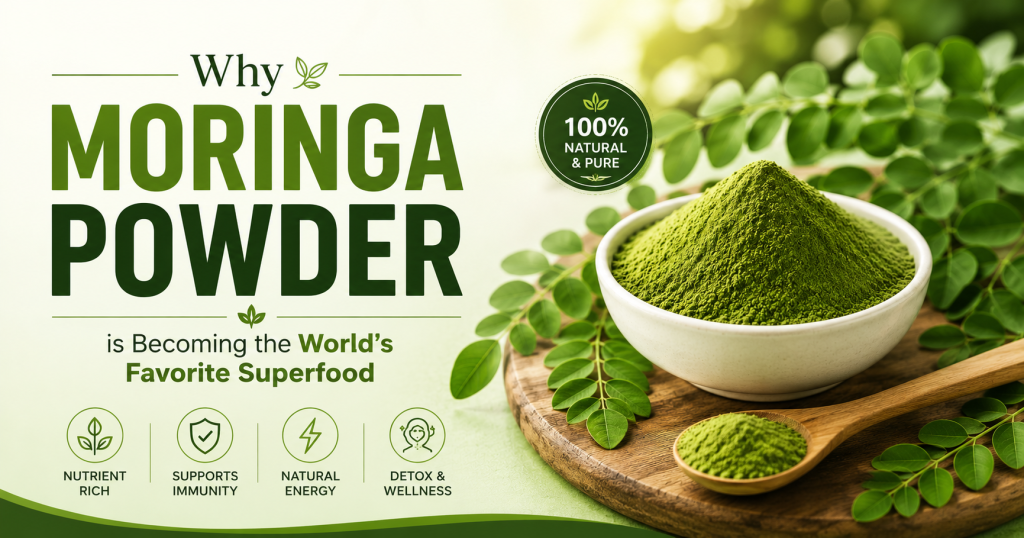
Why Moringa Powder is Becoming the World’s Favorite Superfood
The global wellness industry is undergoing a massive paradigm shift, and at the absolute center of it is a vibrant green botanical powerhouse: Moringa Oleifera. Once a well-kept secret of traditional Ayurveda, this “Miracle Tree” has rapidly transitioned into a dominant global commodity, driven by an insatiable consumer demand for clean-label, nutrient-dense ingredients. For international importers, functional food manufacturers, and health supplement brands, understanding the meteoric rise of this ingredient isn’t just about riding a health trend it’s about locking in a highly lucrative, recession-proof supply chain with the right moringa powder supplier in india.
In this comprehensive guide, we will break down the exact commercial drivers behind the global Moringa boom, analyze why sourcing origin matters, and provide actionable insights on how global buyers can secure premium quality to dominate their respective markets.
1. The Global Moringa Market Shift: From Niche Trend to Mainstream Superfood
To understand why Moringa is capturing the global market, we must look at the shifting priorities of the modern consumer. Post-pandemic consumers are no longer just looking for “healthy” foods; they are actively seeking out preventative nutrition, botanical immunity boosters, and plant-based protein alternatives.
Driven by Clean-Label and Functional Food Demands
From the USA and Europe to the Asia-Pacific region, food formulation matrices are changing. Consumers want shorter ingredient lists with recognizable, plant-derived components. Moringa powder fits this demand flawlessly. It requires minimal processing, is inherently gluten-free, non-GMO, and carries an exceptionally low glycemic index.
Major global brands are now incorporating it into:
- Nutraceuticals & Supplements: Capsules, tablets, and green superfood blends.
- Functional Beverages: Ready-to-drink (RTD) teas, wellness shots, and protein shakes.
- Cosmeceuticals: Anti-aging serums, hair masks, and skin-barrier creams.
- Snack & Bakery Sector: Fortified energy bars, healthy snacks, and specialized pastas.
Market Size and Exponential Growth Projections
The numbers speak for themselves. The global Moringa market size was valued at approximately USD 9.5 Billion in recent years and is projected to expand at a Compound Annual Growth Rate (CAGR) of over 9.5% through the next decade. Importers who secure early, stable partnerships with reliable moringa powder exporters in india are positioning themselves to capture the lion’s share of this multi-billion-dollar expansion.
2. The Nutritional Blueprint: Why Buyers are Choosing Moringa Over Match and Spirulina
For procurement managers, product developers, and supplement brands, marketing a product requires a rock-solid nutritional value proposition. Moringa powder easily outperforms legacy green superfoods like Matcha, Spirulina, and Wheatgrass on multiple fronts.
+———————————————————————–+
| MORINGA POWDER: THE NUTRITIONAL POWERHOUSE |
+—————————+——————————————-+
| 7x More Vitamin C | Than Oranges |
| 10x More Vitamin A | Than Carrots |
| 17x More Calcium | Than Milk |
| 9x More Protein | Than Yogurt |
| 15x More Potassium | Than Bananas |
| 25x More Iron | Than Spinach |
+—————————+——————————————-+
Essential Amino Acids and Plant-Based Protein
Unlike many plant sources, Moringa is a complete protein, meaning it contains all nine essential amino acids that the human body cannot synthesize on its own. This makes it an incredibly high-value ingredient for the booming vegan and plant-based fitness sectors.
Unmatched Antioxidant Profile
Moringa leaves are densely packed with antioxidants, including Quercetin (which helps lower blood pressure) and Chlorogenic Acid (which stabilizes blood sugar levels). For functional medicine and nutraceutical brands, these verifiable bio-actives provide the exact scientific backing needed to justify premium retail pricing.
3. Why India is the Undisputed Global Capital for Moringa Sourcing
While Moringa grows in various tropical regions across the globe, India accounts for nearly 80% of the world’s Moringa production. For global B2B buyers, importing from the best moringa powder supplier located in India offers unparalleled strategic advantages.
Ideal Agro-Climatic Conditions
Moringa thrives best in well-drained sandy or loamy soils and requires a warm, sub-tropical climate. India’s unique geographical topography provides the absolute perfect ecosystem for cultivating Moringa trees that yield leaves with maximum chlorophyll and nutrient retention.
Year-Round Cultivation and Scalability
Unlike European or North American botanical crops that are strictly seasonal, Indian agricultural infrastructure allows for year-round harvesting and processing. This constant supply cycle ensures that international importers face minimal risk of stockouts or sudden supply chain disruptions.
Advanced Industrial Processing Capabilities
Top-tier Indian exporters have heavily invested in state-of-the-art processing facilities. From automated washing and low-temperature dehydrators (which preserve the vibrant green color and delicate nutrients) to advanced pulverization and micro-milling, India offers world-class manufacturing standards that comfortably meet strict international regulations.
4. Key Challenges in Moringa Sourcing and How to Overcome Them
Navigating international supply chains for botanical powders requires meticulous quality control. Unregulated sourcing can lead to significant business losses due to customs rejections, product recalls, or compromised shelf life.
1. Microbiological Contamination & Heavy Metals
Because Moringa leaves are harvested from fields, they are naturally exposed to environmental elements. Substandard processing can leave behind harmful pathogens like Salmonella, E. coli, or high levels of heavy metals (Lead, Arsenic, Cadmium).
- The Solution: Always mandate that your moringa powder supplier in india provides comprehensive Certificate of Analysis (CoA) reports from accredited third-party laboratories (like SGS, Eurofins, or TUV) for every single batch.
2. Adulteration and Color Faking
Due to high demand, some unethical suppliers mix Moringa powder with cheaper fillers or use artificial food coloring to mimic the bright green hue of premium quality leaves.
- The Solution: Look for suppliers who maintain complete transparency in their supply chain. Conduct rigorous testing for moisture content (which should ideally be below 7-8% to prevent mold growth) and verify the pure botanical identity through microscopic and chemical analysis.
3. Strict Regulatory Compliance
Importing food-grade ingredients into regions like the EU (under EFSA regulations) or the US (under FDA compliance) requires meticulous documentation, including Phytosanitary Certificates, organic verifications, and strict adherence to Maximum Residue Limits (MRLs) for pesticides.
5. Checklist for Sourcing from the Best Moringa Powder Supplier
When vetting potential manufacturing and export partners in India, procurement teams should use the following evaluation framework to ensure they are partnering with a world-class enterprise:
- [ ] Certified Processing Facilities: Ensure the exporter’s facility holds globally recognized food safety certifications such as GMP, HACCP, ISO 22000, and FSSC 22000.
- [ ] Organic Certifications: If you are catering to the premium organic segment, verify that the supplier holds genuine USDA Organic, EU Organic, or India Organic (NPOP) certifications.
- [ ] In-House Quality Control (QC) Labs: A reliable partner will have an operational, sophisticated laboratory to test moisture, mesh size, ash content, and microbial load before the consignment leaves the factory floor.
- [ ] Customizable Packaging Options: Whether you require bulk 25kg double-layered LDPE bags in corrugating fiber drums for industrial manufacturing, or vacuum-sealed aluminum bags to preserve freshness during long maritime transit, your supplier must offer versatile packaging solutions.
- [ ] Proven Track Record in Logistics: Ensure the exporter has a dedicated logistics department capable of handling complex international shipping documents, ocean freight bookings, and customs clearance protocols efficiently.
Conclusion: Capitalize on the Global Green Gold Rush
The global demand for Moringa powder is not a passing fad; it is a permanent integration into the modern global wellness blueprint. As consumer awareness continues to scale exponentially, the brands that secure high-quality, sustainable, and strictly compliant raw material supply lines today will inevitably lead the market tomorrow.
Partnering with an experienced, transparent, and quality-driven moringa powder supplier in india is your gateway to capitalizing on this massive commercial opportunity. By ensuring strict adherence to international testing standards and focusing on sustainable sourcing, you can deliver a product that truly honors the “Miracle Tree” label while significantly boosting your brand’s bottom line.
6. Frequently Asked Questions (FAQs) – Sourcing Moringa Powder Bulk
Q1: What is the standard mesh size for commercial Moringa leaf powder?
For most food, beverage, and supplement applications, the standard industry mesh size ranges between 60 mesh to 100 mesh. A finer mesh (like 100 mesh) ensures excellent solubility and a smooth texture, making it perfect for ready-to-drink green blends and cosmetics, while 60–80 mesh is widely used for encapsulation.
Q2: How do you verify if a Moringa powder supplier in India is truly organic?
To ensure your imports aren’t flagged at customs, look for a supplier providing valid transaction certificates under recognized international systems like USDA Organic (for the USA) or EU Organic (for Europe), which map back to India’s NPOP (National Programme for Organic Production). True organic suppliers can track every batch directly back to the certified farm level.
Q3: What is the standard shelf life of bulk Moringa powder?
When stored in optimal conditions cool, dry environments away from direct sunlight and tightly sealed premium bulk Moringa powder maintains a shelf life of 24 months from the date of manufacture. Vacuum-sealed or aluminum foil lining inside bulk drums is highly recommended for long-term maritime transit to maintain maximum potency.
Q4: Why is there a price variation among different moringa powder exporters in India?
Price differences usually come down to the processing methodology. Leaves that are mechanically shade-dried or low-temperature dehydrated retain a bright green color and higher nutrient profile, commanding a premium price. Conversely, cheaper Moringa powder is often sun-dried on open fields, which exposes the product to dust, high microbial contamination, andUV degradation, turning the powder a dull yellowish-brown.
Q5: Can I request customized packaging for white-label or private-label retail?
Yes, the best moringa powder supplier networks in India offer both bulk industrial packaging (such as 25kg HDPE drums or craft paper bags) and retail-ready private label packaging. Options generally include stand-up zipper pouches, aluminum foil gusset bags, and custom-printed jars, allowing you to import products that are completely shelf-ready.
Q6: What are the mandatory documents required for importing Moringa powder from India?
To ensure hassle-free customs clearance, your Indian exporter must provide:
- Certificate of Analysis (CoA) including Microbiological and Heavy Metal testing.
- Phytosanitary Certificate issued by the Government of India.
- Commercial Invoice, Packing List, and Bill of Lading (B/L).
- Organic Transaction Certificate (if importing organic grade).
- Product specification sheet and MSDS (Material Safety Data Sheet).